
the alternatives institute
with Westbrooke
Navigating beyond traditional markets for South African investors
Welcome to Westbrooke’s Alternatives Institute.
In a rapidly changing economic landscape, traditional 60/40 portfolios of stocks and bonds are no longer sufficient to meet the evolving needs of investors.
As South Africa’s leader in global alternative asset management, Westbrooke Alternative Asset Management has prepared a series of carefully curated lessons to assist South African direct investors, wealth managers and institutions better understand private markets and how including these assets in well-diversified portfolios can result in better long-term portfolio outcomes.
what is an alternative investment?
Alternative investments are best explained as any investment that falls outside the traditional asset classes of publicly traded equities, bonds, and cash. They offer a unique way to generate yield, capture growth and diversify away from standard market volatility.
Alternatives are primarily traded in the private markets, meaning they are not listed on public exchanges like the JSE. Access to these types of investments has historically been out of reach to all but the wealthiest global families. Westbrooke Alternative Asset Management was established to provide South African connected capital with a gateway to the global world of alternatives.
Key characteristics and benefits
- More pricing stability and lower correlation: Their performance is not directly tied to the daily fluctuations and sentiment of the public stock market.
- Higher absolute value returns: Investments are often held for a longer term, compensating investors with a higher potential return, referred to as an “illiquidity premium”.
- Active management: Specialised expertise is required to source, manage, and exit these types of investments.
key benefits of allocating to alternatives
The 60/40 portfolio
For years, the traditional “60/40 portfolio” (60% equities, 40% bonds) was the gold standard. This relied on the assumption that when the values of equities fall, bonds will rise providing a natural hedge. This held true in the era of high growth and low inflation, but today we are in an environment of low growth and high inflation meaning that those asset classes are now heavily correlated. In short, what worked well for decades gone by no longer works in today’s world.
Shrinking public markets
The number of listed companies has roughly halved since 1996, making the global addressable listed investment universe extremely concentrated. By way of example, the JSE had over 600 companies listed in 2000; today there are around 270 companies listed. The S&P 500 similarly reflects this trend, with the broader US market seeing its total number of listed companies drop from over 8,000 in 1996 to roughly 4,000 today, limiting the pool of available public investments. If you allocate 100% of your capital to public markets, you are ignoring 87% of global companies with revenues over $100 million.
the number of listed companies has shrunk substantially since the mid 90s
Hover over data points for detailed information
Data sources: World Bank, Center for Research in Security Prices (CRSP), JSE Annual Reports, London Stock Exchange.
Companies stay private for longer
The Magnificent 7 (Apple, Microsoft, Alphabet, Amazon, Nvidia, Meta and Tesla) are dominant US tech-focused stocks that comprise roughly 34% of the S&P 500 market capitalisation and accounted for over 40% of the index's total return in 2024. This significant weight in the index creates high concentration risk. Similarly, on the JSE, gold / platinum miners and big tech conglomerates (like Naspers / Prosus) make up a disproportionate percentage of the JSE top 40 index.
companies stay private for longer
Hover over data points for detailed information
Sources: Professor Jay Ritter, University of Florida IPO Database and PitchBook Data, Inc.
Concentration risk
The Magnificent 7 (Apple, Microsoft, Alphabet, Amazon, Nvidia, Meta and Tesla) are dominant US tech-focused stocks that comprise roughly 34% of the S&P 500 market capitalisation and accounted for over 40% of the index's total return in 2024. This significant weight in the index creates high concentration risk. Similarly, on the JSE, gold / platinum miners and big tech conglomerates (like Naspers / Prosus) make up a disproportionate percentage of the JSE top 40 index.
Private markets are no longer just an optional add-on; they are a strategic necessity to find true diversification and to capture the pre-IPO growth which was historically reserved for a select few.
See how Westbrooke's private market strategies provide a solution to public market volatility.
View our investment calendar to see currently available investments →how sophisticated investors allocate globally
While South Africa has historically lagged in alternative asset adoption, global wealth managers view private markets as essential. As investor wealth grows, so does their reliance on the private markets for yield, growth, and capital preservation.
To understand the true impact of private markets, we can look at historical performance across different economic cycles. According to comprehensive data from KKR (analyzing returns up to December 2023), replacing a portion of traditional equities and bonds with a 30% allocation to alternatives drastically improves portfolio resilience.
Portfolio comparison
portfolio comparison
Hover over data points for detailed information
Across all periods, the inclusion of alternatives not only increased overall returns but also drastically reduced portfolio volatility. This impact is even more pronounced in our current environment of high inflation and low growth, where the data shows a 60/40 portfolio returning a flat 0.1%, compared to a 2.1% return when alternatives are included.
Using annual total returns from 1928 to 2023 for U.S. Bonds and from 1987 to 2023 for Private Credit. Data as at December 31, 2023. Source: KKR 2023
Global wealth allocations
According to global wealth data (KKR Global Macro & Asset Allocation, 2024), here is how the world's most sophisticated investors are currently allocating:
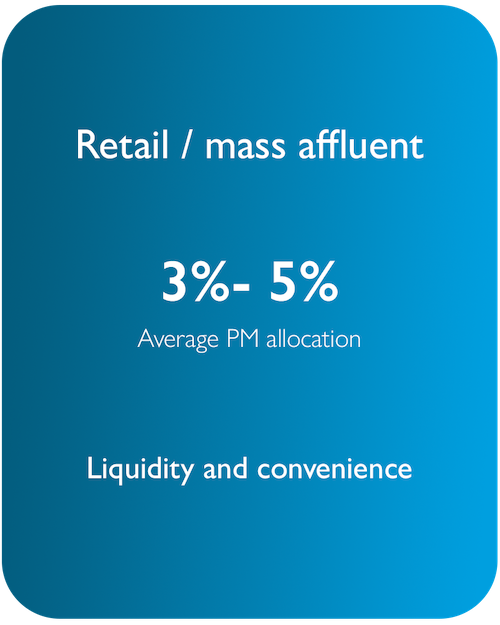
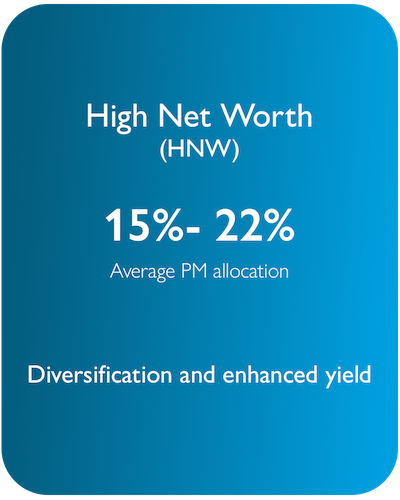
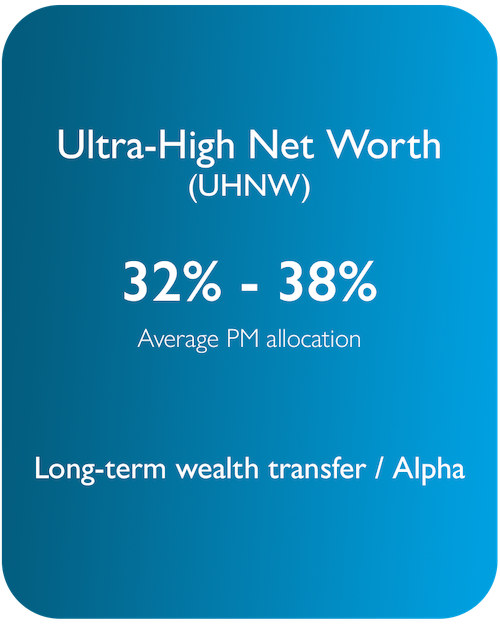
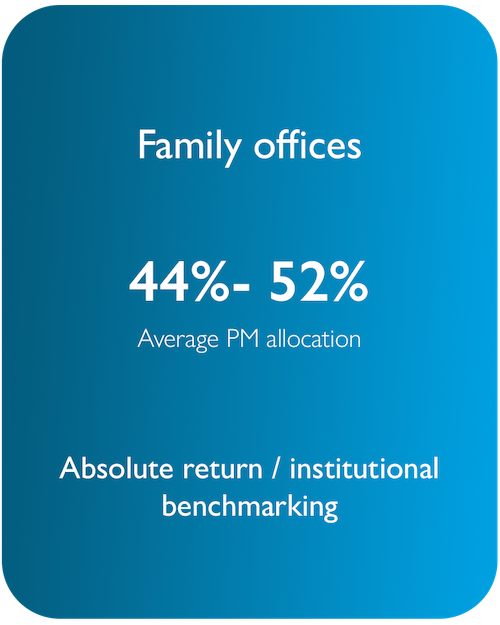
Note: Allocation percentages differ wildly between investor types, liquidity needs, and risk profiles. However, increasing alternative exposure is widely considered a key step toward building a resilient, globally diversified portfolio.
Speak to our distribution team about incorporating alternatives into your practice
Contact our team →strategic benefits of allocating to alternatives
Adding alternatives to a portfolio isn't about replacing traditional assets; it's about complementing them to achieve specific outcomes. Leading global institutions (like the Yale Endowment) have historically allocated upwards of 30-50% of their portfolios to alternatives to capture these exact benefits.
Depending on the asset class, alternatives deliver distinct advantages to a portfolio:
Private equity captures value and exponential growth before a company lists on a public exchange.
Private debt and real estate provide regular, contractual cash yields that act as a strong hedge against inflation.
Senior secured private debt sits at the top of the capital structure, offering significant downside protection compared to public equities.
considerations, drawbacks and offshore complexities
While alternative investments provide distinct advantages, they are complex instruments. Investors and wealth partners must carefully consider several factors, particularly when allocating capital offshore:
Many alternative investments require capital to be locked up for extended periods (ranging from 1 to 7+ years depending on the asset class), meaning investors cannot access their funds on daily notice.
Historically, these investments require high minimum investment amounts that put them out of reach for the average retail investor.
Investing outside of South Africa introduces complexities regarding tax structuring, utilising offshore allowances, and physically moving money across borders.
The private markets are opaque. Unlike buying a listed index tracker, success in alternatives relies entirely on the manager's ability to source deals, manage risk, and navigate foreign jurisdictions. Accessing top-tier global managers from South Africa is notoriously difficult without a trusted local partner.
a closer look at key alternative asset classes
Importantly, each of these asset classes can be accessed both locally and globally, providing South African investors with offshore diversification and hard-currency capital preservation.
a closer look at key alternative asset classes
| Asset class | What it is | Why it matters | Primary goal | Risk profile | Investment horizon |
|---|---|---|---|---|---|
| Private debt | An investment strategy where non-bank lenders provide loans to support the financing objectives and requirements of businesses, typically secured by company assets and generating a regular cash yield. | Provides predictable, contractual income stream, lower correlation to listed markets, more pricing stability, and higher absolute value returns. | Predictable income and capital preservation | Lower (senior secured) | Short to medium term |
| Hybrid capital | A debt-led investment strategy that blends the downside protection of structured lending with equity upside participation. | Offers companies flexible growth capital without immediately diluting the owners' shares. Investors get contractual interest income plus capital upside. | Income generation with capital growth upside | Moderate (Subordinated to senior debt) | Medium term (3-5 years) |
| Private equity | Investing directly into the ownership of private companies. | Managers take an active role in growing and improving businesses. Requires longer-term commitment but targets significant capital growth. | Significant capital growth (Alpha) and absolute return | Higher (Equity position) | Long term (5-7+ years) |
| Real estate | Direct investment in physical properties (commercial, residential, or specialised like logistics and student housing). | Asset is highly tangible - investors can physically see it and understand underlying value. Provides strong physical asset backing and reliable rental income. | Tangible asset backing, inflation-linked yield, and capital appreciation | Moderate to high (Dependent on sector) | Medium to long term (3-7 years) |
looking ahead - the global convergence
According to McKinsey's latest Asset Management report, the dominant theme for the next five years is "The Great Convergence" between traditional and alternative asset management. This is not just a marketing term; it is a fundamental restructuring of how capital is sourced, managed, and distributed globally.
For South African investors and wealth managers, the next decade will look vastly different from the last:
Historically, private markets required rigid 7-to-10-year lockups. Today, the number of active "Evergreen" (open-ended) vehicles has surged globally. Industry forecasts suggest these semi-liquid structures will represent over 20% of all private market assets within the next decade.
The lines between public and private are blurring. From new Public-Private ETFs (blending 85% listed equities with 15% private credit) to the future potential of asset tokenisation, private markets are rapidly being fitted into the "pipes" of the traditional investment ecosystem.
While South Africa has historically lagged global alternative allocations due to regulatory and platform (LISPs) constraints, widescale adoption is imminent. Expect to see significant local regulatory reforms and increased collaboration between traditional asset managers and private market specialists.
unlocking global private markets for south african investors
At Westbrooke, our goal is to serve as your gateway to alternative investment opportunities. We recognise the unique regulatory and structural complexities faced by South African investors, and our focus is on bridging the gap between global private markets and local portfolios.
Rather than relying solely on traditional lock-up structures, we seek to make private market allocation more seamless and accessible. We do this by:
- Operating Evergreen (open-ended) investment vehicles across our product range that offer periodic liquidity.
- Registering local funds as Qualified Investor Hedge Funds (QIHFs).
- Utilising offshore Actively Managed Certificates (AMCs) to facilitate alternatives within local portfolios.
As the global investment landscape continues to evolve, understanding and accessing private markets will remain a vital component of long-term wealth preservation and growth. We invite you to explore the rest of this toolbox to deepen your understanding of these strategies and how they might complement a well-diversified portfolio.
ready to rethink your portfolio?
Explore how these strategies could diversify your portfolio